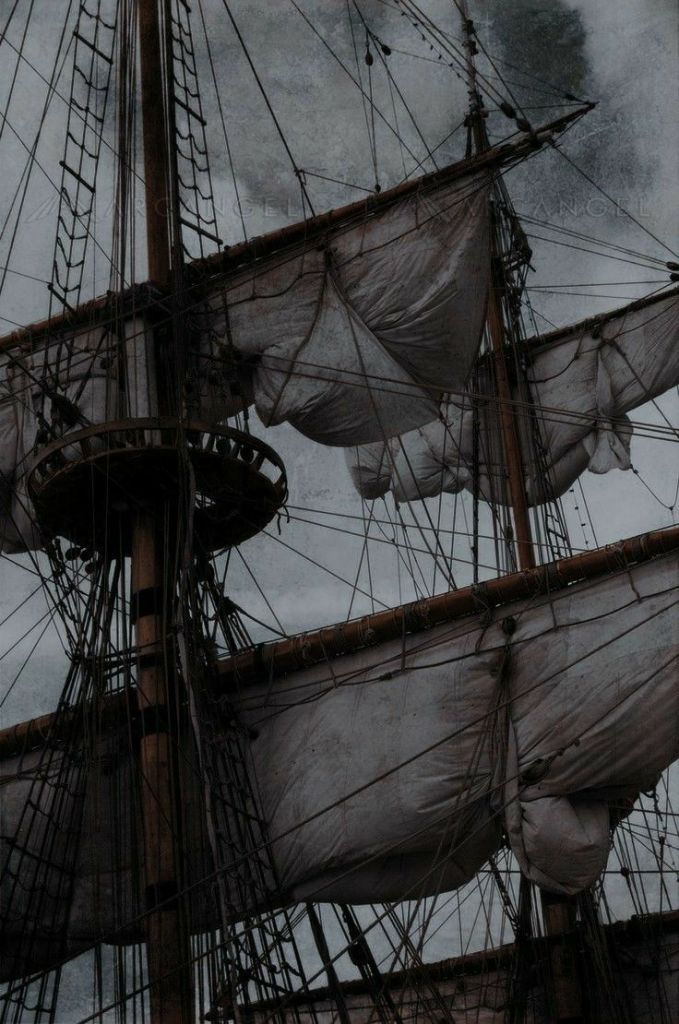
The seagulls barely unsettle me anymore. Instead of hovering around, screaming for attention like they do at home, they sit on the masts in silence, as if they’re watching me. I pretend I don’t see them, I close my eyes. The sound of water sloshing against dark wood has been keeping me company ever since I entered the harbour. I’m not sure how long ago that happened. There’s a certain timelessness on board, I feel like. That’s what eating the same food and seeing the same faces every day for such a long time does to you.
I’m headed for my lover! I haven’t seen her in ages, I wonder if she still thinks of me. My heart aches when I think of her. All these other passengers, I think they’re like me. Each with a goal, some unfinished business. They may not always talk about it, but I can see the longing in their faces when they gaze out over the neverending sea. When I give them enough drink they get loose-lipped. This one wants to make good with his father. That one wants to make their village proud…
The sky ahead is a deep grey, tonight, with an array of stars keeping me company. I look down at my compass, compare it to the sky, and steer us north.
Obol was a bittersweet, text- based roleplaying game about a journey and took place from March 6th to July 6th 2024, through which 10 to 12 players could play at will.
All players played characters who were both crew and passengers on a mysterious ship named ‘the Obol’. Under the wing of Captain Norach, they sailed and lived on the Obol together. They learned to know the other passengers and discovered that every one of them had some kind of unfinished business that was holding them back. They made friends, found family, laughed and cried… until they reached the point that they were ready to move on, and were brought to Lily Harbour, where they left the ship.
The game revolved around themes such as reminiscence, unfinished business, found family, saying goodbye and liminal space. The game had a magical realist atmosphere.
This game was designed to be player- driven. Through an extensive character design process, players created layered and complex characters that were able to generate their own conflict. All characters received a specific role on the ship, such as cook, sailor or navigator. Play took place only on the ship, the Obol, where players could write out their scenes in specific channels such as ‘the Captain’s Office’, ‘the Front Deck’, ‘the Crow’s Nest’ and so on. Every channel got an initial description, after which players took over. The game masters only intervened when players signalled a ‘dip’ in the story, and intervened by presenting them with a conflict or a challenge. This could, for example, be a big storm or a party. When players had practical or narrative- driven questions, they could ask them in specific channels.
This game was designed and has managed to facilitate processes of transformation within players. Players have reported that, through play, they were able to explore and work through fears such as being forgotten.
Design and game master Hanne Driessens
Advisor and game master Siri Sandquist


 Hanne Driessens
Leave a comment